

Vision Correction · EVO ICL · Los Angeles & Santa Monica
ICL Surgery in Los Angeles:
Are You an EVO ICL Candidate?
Strong prescription? Told you’re not a LASIK candidate? The implantable collamer lens corrects nearsightedness from inside the eye — here’s how to know if it’s right for you.
You may be a good candidate for EVO ICL surgery if you are 21 to 60 years old, nearsighted between −3.0 and −20.0 diopters (with or without up to 4.0 diopters of astigmatism), have had a stable prescription for about a year, and have healthy eyes with enough internal space for the lens.
ICL is often the best option for people with high prescriptions, thin corneas, or dry eye who have been told they aren’t LASIK candidates. In Los Angeles, Dr. Barry Seibel determines candidacy with precise measurements at his Santa Monica office.
If you’ve worn thick glasses or contacts since grade school — or been told you aren’t a LASIK candidate — ICL surgery may be the vision-correction option you haven’t seriously considered.
The EVO Implantable Collamer Lens (ICL) corrects nearsightedness from inside the eye, without removing any corneal tissue, and it can be removed if your needs ever change. Below, we explain how Dr. Barry Seibel evaluates EVO ICL candidates, and how to tell whether ICL, LASIK, or a lens-replacement procedure is the better fit for your eyes.
What Is ICL Surgery?
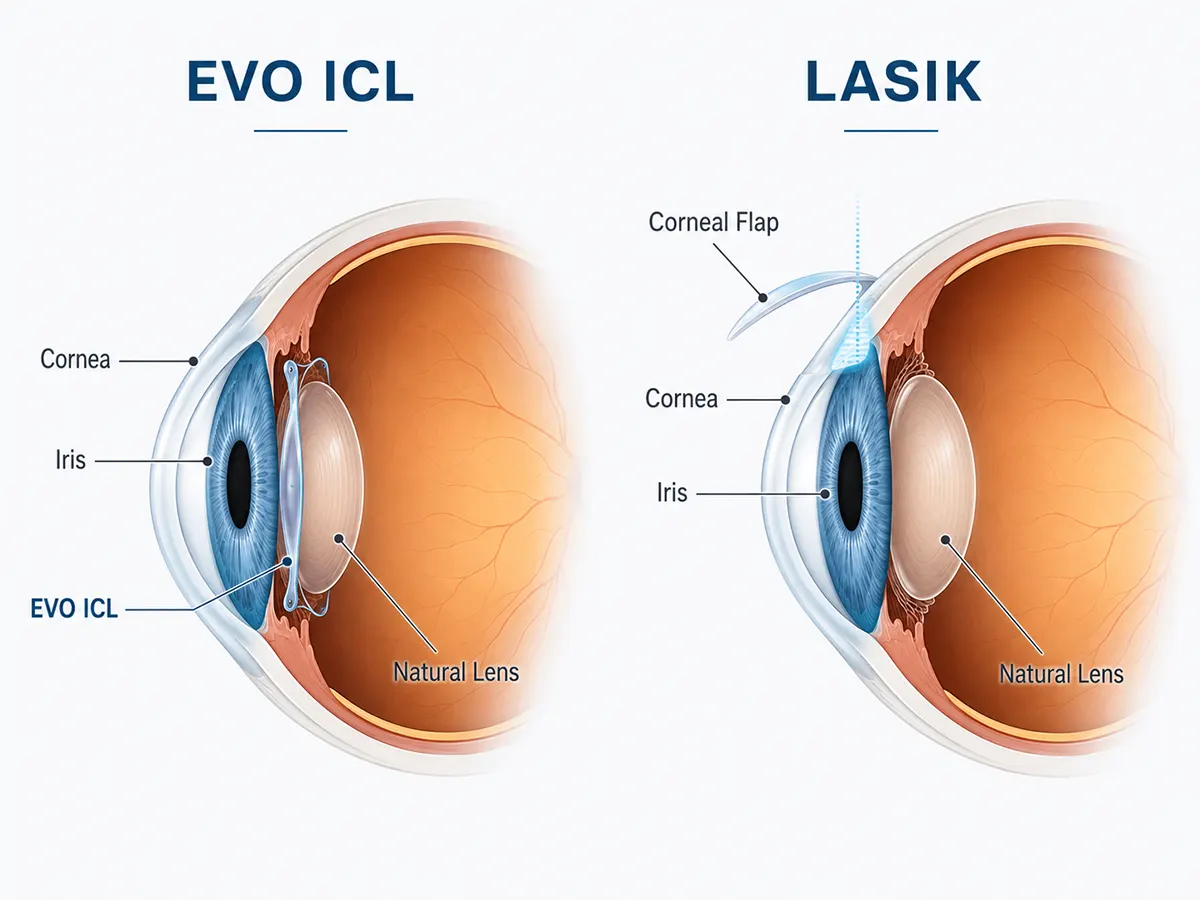
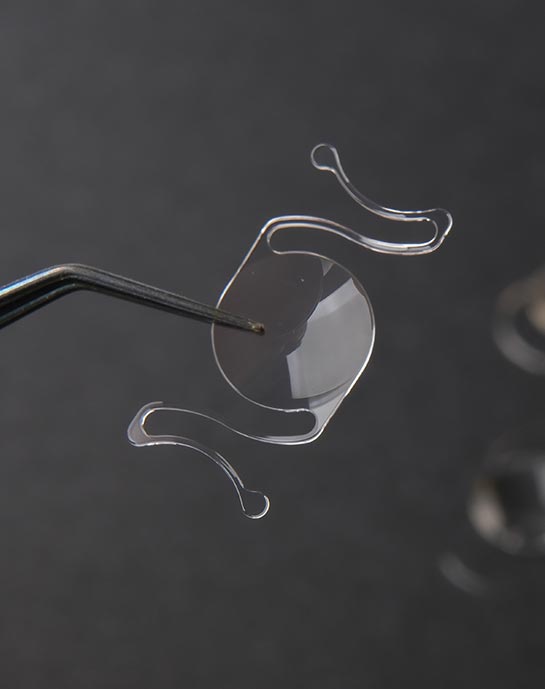
ICL surgery places a thin, flexible lens inside the eye — behind the iris (the colored part of the eye) and in front of your natural lens. Ophthalmologists call it a phakic intraocular lens, or phakic IOL. “Phakic” simply means your natural lens stays in place. That’s the key difference from cataract surgery and Refractive Lens Exchange, which replace the natural lens.
The EVO Visian ICL is made by STAAR Surgical from a biocompatible material called Collamer and was FDA-approved in the United States in 2022. According to the manufacturer, more than 4 million ICLs have been sold in over 85 countries. The EVO design adds a tiny central port that lets fluid flow naturally inside the eye, eliminating the separate laser procedure that earlier ICL designs required.
Who Is a Good Candidate for EVO ICL?
Candidacy comes down to five factors. Dr. Seibel confirms each one with detailed imaging at your consultation — not just a glance at your glasses prescription.
You’re between 21 and 60 years old
In February 2026, the FDA expanded the EVO ICL’s approved age range from 21–45 to 21–60. That opened the door for many Los Angeles adults in their late 40s and 50s who want freedom from glasses and contacts.
What we evaluate: whether age-related changes — early presbyopia (difficulty reading up close) or the first signs of a cataract — mean a lens-replacement procedure would serve you better over the long term.
Your nearsightedness is between −3.0 and −20.0 diopters
EVO ICL is approved for moderate to very high myopia, and a toric version also corrects 1.0 to 4.0 diopters of astigmatism. That range extends well beyond what laser vision correction can safely treat, which is why ICL is so often the answer for patients with strong prescriptions.
What we evaluate: your exact prescription and astigmatism, measured and confirmed in our office.
Your prescription has been stable
Any permanent vision correction works best when your prescription has stopped changing — typically stable for about a year. If your numbers are still climbing, it’s worth waiting.
What we evaluate: prior eyeglass or contact lens records that confirm stability.
Your eye has enough room for the lens
The ICL sits in a narrow space in the front of the eye. Adequate depth in that space (the anterior chamber) and a healthy layer of cells lining the back of the cornea (the endothelium) are essential. The same measurements determine your lens size — one of the most important factors in a great long-term result.
What we evaluate: anterior chamber depth, corneal endothelial cell count, and the internal dimensions used to size your lens.
Your eyes are otherwise healthy
Conditions such as uncontrolled glaucoma, chronic inflammation inside the eye (uveitis), or an existing cataract generally rule out ICL. A dilated exam also checks the retina and optic nerve — especially important in highly nearsighted eyes.
What we evaluate: a complete picture of your eye health, not just your prescription.
When Another Procedure May Be a Better Fit
A good consultation should tell you when ICL isn’t your best option. Because Dr. Seibel performs LASIK, PRK, EVO ICL, Refractive Lens Exchange, and cataract surgery, his recommendation isn’t tied to a single procedure.
Consider an Alternative If You…
- Are in your mid-40s or older and already need readers — Refractive Lens Exchange can address distance and near vision together
- Have early cataract changes — cataract surgery with a premium lens implant may be the smarter long-term move
- Have a mild prescription and healthy, thick corneas — LASIK or PRK may be simpler and less expensive
- Have a shallow anterior chamber or a low endothelial cell count
- Are pregnant or nursing — prescriptions can shift temporarily, so it’s best to wait
EVO ICL vs. LASIK: Which Is Better?
Neither is better for everyone. EVO ICL tends to be the stronger choice for high prescriptions, thin or irregular corneas, and dry-eye-prone patients. LASIK is usually faster and less expensive for mild-to-moderate prescriptions with healthy corneas.
| EVO ICL | LASIK | |
|---|---|---|
| How it works | Adds a lens inside the eye | Reshapes the cornea with a laser |
| Corneal tissue removed | None | Yes |
| Removable | Yes | No |
| Myopia range | −3.0 to −20.0 D | Typically up to about −8 to −10 D |
| Thin corneas | Often suitable | Often not suitable |
| Dry eye | Cornea left untouched | Can worsen dry eye, sometimes lasting |
| Visual recovery | Often by the next day | Often by the next day |
| Relative cost | Higher (custom-made lens) | Lower |
General guidelines from FDA labeling and clinical literature. Your candidacy evaluation determines what’s right for your eyes.
Southern California’s dry, sunny climate is a real consideration. LASIK temporarily disrupts corneal nerves and can aggravate dry eye, while the ICL leaves the cornea untouched. The Collamer lens material also includes a built-in UV filter.
Visian ICL vs. EVO ICL: What’s the Difference?
Visian ICL is STAAR Surgical’s family of implantable lenses; EVO is its latest generation. Older Visian ICLs required a small laser opening in the iris (a peripheral iridotomy) before surgery to prevent pressure buildup. The EVO ICL’s central port makes that extra step unnecessary. The EVO ICL is the current-generation lens featured at Seibel Vision Surgery.
What to Expect From ICL Surgery in Santa Monica
Consultation and measurements. Corneal topography, anterior segment imaging, and internal eye measurements at our Santa Monica office determine your candidacy and exact lens size.
Custom lens order. Each EVO ICL is ordered to your prescription and eye dimensions. Lenses typically arrive within two to three weeks.
Surgery day. With numbing drops and mild sedation, the procedure takes about 15 minutes per eye. The folded lens passes through a tiny, self-sealing incision — no stitches.
Recovery. Most patients notice clearer vision within hours and return to desk work within a day or two. You’ll see Dr. Seibel the next day, then at scheduled follow-ups that monitor lens position and eye pressure.
Why Patients Across Los Angeles Choose Dr. Seibel for ICL
ICL results depend on precise sizing and delicate work in a very small space inside the eye — the same skills that define expert cataract and lens surgery. Dr. Barry Seibel is the author of Phacodynamics, the internationally used textbook on intraocular lens surgery. He has designed 20 surgical instruments used by ophthalmologists worldwide and served as an investigator in the original FDA clinical trial of CustomVue LASIK.
His office at 1301 20th Street, Suite 260, in Santa Monica’s Saint John’s Medical Plaza is convenient to Brentwood, Pacific Palisades, Westwood, Beverly Hills, Venice, Marina del Rey, Culver City, and Malibu. For a full overview of the procedure, visit our EVO ICL in Los Angeles page.
Key Takeaways
- ICL surgery places a removable lens inside the eye to correct nearsightedness without removing corneal tissue.
- EVO ICL is FDA-approved for ages 21–60 and −3.0 to −20.0 diopters, with toric lenses for 1.0–4.0 diopters of astigmatism.
- Precise measurements of the space inside your eye determine both candidacy and lens size.
- Patients who already need readers or have early cataract changes may be better served by lens replacement.
- The right consultation compares ICL, LASIK, PRK, and RLE — not just one procedure.
Frequently Asked Questions
Is ICL surgery safe?
EVO ICL has a strong safety record. In a three-year FDA clinical study of 629 eyes, there were no reported cases of pupillary block, and the rate of anterior subcapsular cataract was 0.16%. As with any eye surgery, risks exist; careful lens sizing and follow-up care help minimize them.
How long does an ICL last?
The ICL is designed to stay in the eye permanently with no maintenance. Unlike LASIK, it can also be removed or exchanged by a surgeon if your vision needs change, or when cataract surgery is needed later in life.
Can I get ICL surgery if I’m over 45?
Yes. Since February 2026, the FDA-approved age range for EVO ICL extends to 60. Whether it’s your best option depends on your near vision and lens health. If you already rely on readers or show early cataract changes, Refractive Lens Exchange may be the better long-term choice.
Does ICL correct astigmatism?
Yes. The toric EVO ICL corrects 1.0 to 4.0 diopters of astigmatism along with nearsightedness.
How much does ICL surgery cost in Los Angeles?
In the Los Angeles market, EVO ICL typically costs about $4,500 to $5,500 per eye, depending on whether you need a toric lens and what the quote includes. Our EVO ICL cost guide explains what to look for in a quote.
Where can I get ICL surgery near Santa Monica?
Dr. Barry Seibel sees EVO ICL patients at 1301 20th Street, Suite 260, Santa Monica, CA 90404, in Saint John’s Medical Plaza. Call (310) 444-1134 or request an appointment online.

Find Out If You’re an EVO ICL Candidate
Schedule a consultation with Dr. Barry Seibel in Santa Monica. You’ll get precise measurements and an honest recommendation — ICL, LASIK, or another option.
Or call us directly: (310) 444-1134