
Patient Story · Los Angeles Cataract Surgery
When the Expert Becomes the Patient:
Why a Surgeon With 40 Years of Experience
Chose Dr. Barry Seibel
Renowned USC ophthalmologist Dr. Donald N. Schwartz spent decades training surgeons. When cataracts threatened his own vision, he turned to one man — his former student and the Los Angeles cataract surgeon who literally wrote the textbook.
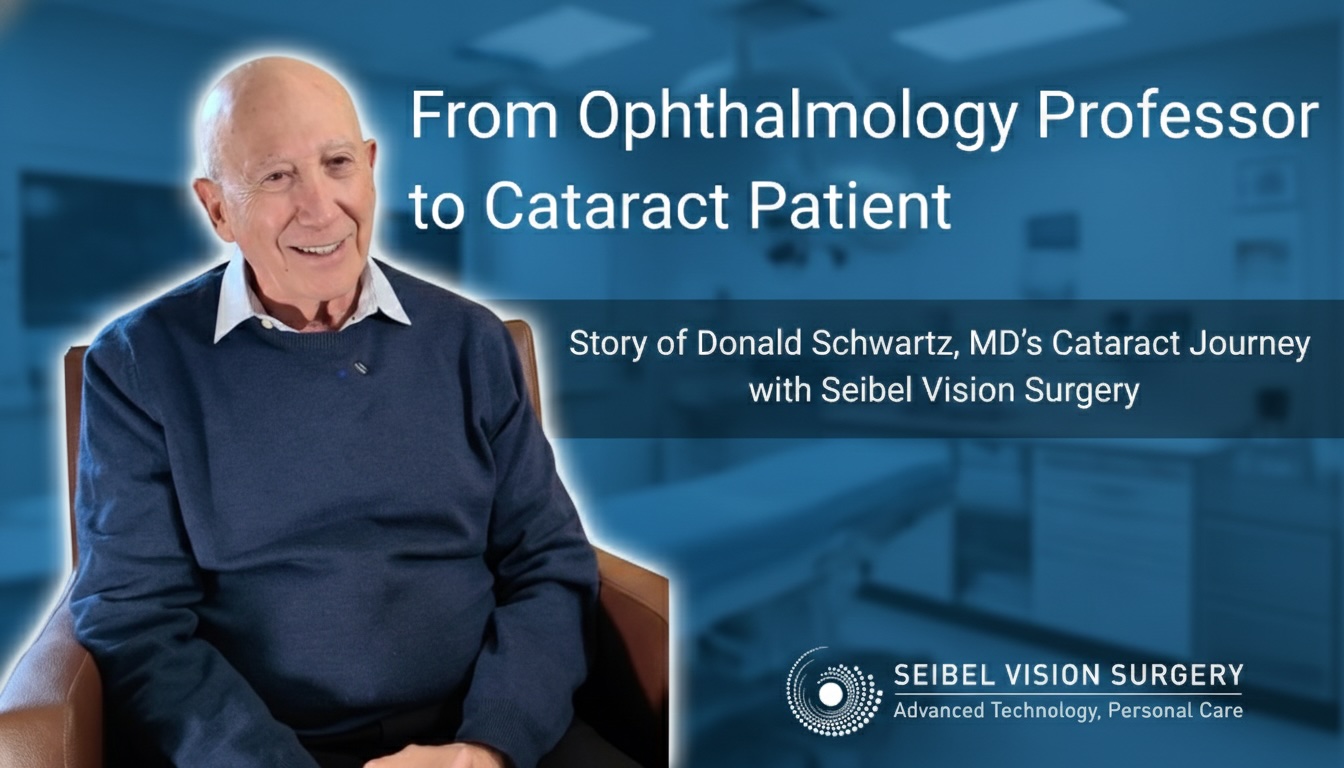
Dr. Donald N. Schwartz, USC Professor of Ophthalmology, shares why he chose Dr. Barry Seibel as his own cataract surgeon.
Dr. Donald N. Schwartz — a board-certified ophthalmologist, former USC Keck School of Medicine faculty member, and a surgeon with more than 40 years in practice — chose Dr. Barry Seibel of Seibel Vision Surgery in Santa Monica for his own cataract surgery.
He selected a toric intraocular lens to correct his astigmatism and achieve clear vision at all distances. After surgery he reported the immediate return of accurate color perception, resolution of the double vision that had affected his tennis game, and freedom from glasses.
When you have spent forty years as an ophthalmologist — training residents, performing surgery, and teaching at one of the country’s top academic medical centers — you know exactly what good surgical care looks like. You also know exactly who you want holding the instruments when it is your turn to be in the chair.
For Dr. Donald N. Schwartz, board-certified ophthalmologist, former faculty member at the University of Southern California Keck School of Medicine, and a physician widely respected among Los Angeles’s eye care community, that answer was unequivocal: Dr. Barry Seibel of Seibel Vision Surgery.
In this candid interview, Dr. Schwartz shares what led him to seek cataract surgery in Los Angeles, how he evaluated his options, and why he chose a former student who has since become a world authority on the procedure.
“Of all the surgeons that I know, I wouldn’t hesitate to recommend anybody to have Dr. Seibel do their cataract surgery. As did I — I wouldn’t have gone anywhere else.”
— Dr. Donald N. Schwartz, Ophthalmologist & USC Professor
When Even a Doctor Begins to Notice the Symptoms
Cataracts develop gradually, often so slowly that patients — and even physicians — attribute early changes to normal aging. For Dr. Schwartz, the first signs were subtle but cumulative. On the tennis court, he began experiencing bothersome double vision that interfered with tracking the ball. In everyday settings, he noticed he could no longer reliably distinguish navy blue from black — a shift in color perception that is among the hallmark early symptoms of lens clouding.
“You don’t realize how much the world has dulled until you can suddenly see clearly again,” Dr. Schwartz recalls of his post-surgical experience. These symptoms — color distortion, contrast loss, and visual doubling during dynamic activity — are classic indicators that the eye’s natural crystalline lens has begun to cloud and needs to be replaced.
Common Cataract Symptoms to Watch For
- Blurred or hazy vision that glasses can no longer fully correct
- Colors appearing dull, yellowed, or harder to distinguish (e.g., navy vs. black)
- Double vision or “ghosting” in one eye, particularly during motion
- Increased glare from headlights or sunlight, especially at night
- Frequent changes in eyeglass or contact lens prescription
- Difficulty reading in low light or fine print
A Surgeon Evaluating a Surgeon: The Selection Process
When it came time to choose his own surgeon, Dr. Schwartz approached the decision the same way any rigorous clinician would — with clear criteria and without sentiment. His evaluation centered on three things: technical mastery, technological innovation, and the surgeon’s standing among peers.
Dr. Barry Seibel checked every box. Dr. Schwartz first knew Dr. Seibel as a student, but over the intervening years had watched him grow into one of the most respected cataract and refractive surgery specialists in the country. “I’ve watched Barry develop into an extraordinary surgeon,” Dr. Schwartz explains. “There’s no one I trust more.”
Beyond surgical skill, Dr. Schwartz was influenced by Dr. Seibel’s reputation as a developer of ophthalmic surgical instruments and, critically, as the author of Phacodynamics — the definitive, internationally used textbook on phacoemulsification cataract surgery technique. When a surgeon writes the curriculum that trains other surgeons, that is a standard of expertise that speaks for itself.
Choosing the Right Lens: Precision Vision at Every Distance
A central part of any modern cataract surgery consultation in Los Angeles is the lens selection — choosing the intraocular lens (IOL) implant that will replace the clouded natural lens and, in many cases, correct additional refractive errors at the same time.
Dr. Schwartz came to his consultation with astigmatism — an imperfection in the curvature of the cornea that affects how light focuses on the retina. To address this, he and Dr. Seibel agreed on a Toric IOL, a premium lens implant specifically engineered to neutralize astigmatism and deliver precise, spectacle-independent vision at the distances that matter most to the patient’s lifestyle.
The goal, as Dr. Schwartz described it, was “precision vision” — clarity at all distances without dependence on corrective lenses. This is precisely the philosophy at the core of Dr. Seibel’s practice: matching the optimal technology to each patient’s individual vision goals, anatomy, and daily life.
The Results: “White Is White Again”
What struck Dr. Schwartz most immediately after surgery was not what had been restored — it was how much he hadn’t realized had been lost. The brilliance and contrast of colors returned instantly. White, he noted with evident delight, was white again. The muted, yellowed palette that had quietly colonized his world simply vanished.
His tennis game returned with it — the double-vision that had complicated his game was gone, replaced by sharp, confident depth perception. And perhaps most meaningfully for a physician who had spent decades with readers and charts, he emerged from surgery free of glasses, unencumbered by the correction he had relied on for years.
“The thing that struck me immediately was that white is white — everything was brilliant and clear. The change was remarkable.”
— Dr. Donald N. Schwartz, following cataract surgery with Dr. Barry Seibel
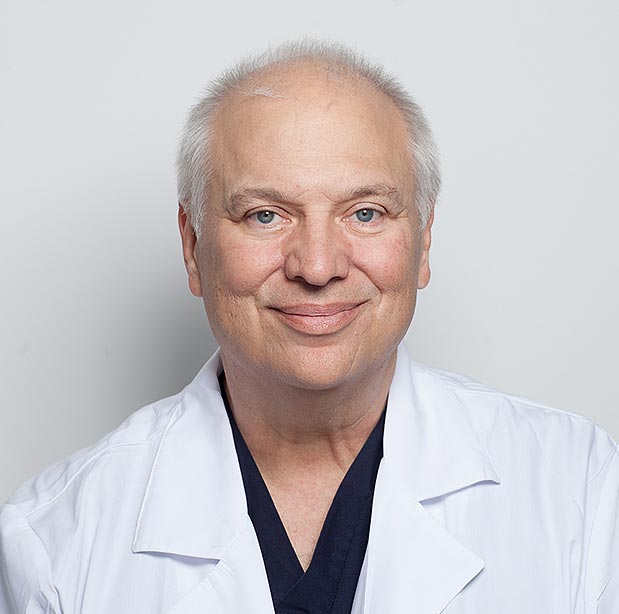
Your Surgeon
Barry S. Seibel, MD
Los Angeles Cataract & Refractive Surgeon
Author, Phacodynamics · Ophthalmic Instrument Developer
Dr. Seibel is recognized internationally as a leader in cataract and refractive surgery. He developed surgical instruments used by ophthalmologists around the world and authored the field’s definitive teaching text. His clinical philosophy — Vision for Your Lifestyle — ensures every patient receives a lens solution tailored to their unique anatomy and life demands.
When the surgeon’s surgeon needs cataract surgery, he calls Dr. Seibel.
Meet Dr. Seibel →What This Means for Patients Considering Cataract Surgery in Los Angeles
Peer endorsements carry a particular weight in medicine. Physicians are a skeptical audience by training — they know too much about what can go wrong to offer praise lightly. When a respected USC professor and practicing ophthalmologist states publicly that he “wouldn’t have gone anywhere else” for his own surgery, that is not a courtesy. It is a clinical judgment.
For patients researching cataract surgery in Los Angeles, Dr. Schwartz’s account answers the question that matters most: in a city with no shortage of eye surgeons, which one do the experts themselves trust?
If you are experiencing blurred vision, color distortion, glare, or difficulty reading — or if your optometrist has mentioned that a cataract may be developing — the next step is a comprehensive consultation with a specialist who can evaluate your lens, your prescription, and your lifestyle goals. That consultation will determine whether surgery is appropriate, which lens implant is right for you, and what you can realistically expect afterward.
Schedule Your Cataract Surgery Consultation with Dr. Seibel
Seibel Vision Surgery is located in Los Angeles, California, and serves patients throughout the greater LA area, including Beverly Hills, Santa Monica, Burbank, Glendale, and the San Fernando Valley. Dr. Seibel accepts referrals from optometrists and primary care physicians, and welcomes self-referred patients who are ready to take the first step toward clearer vision.
Key Takeaways
- Dr. Schwartz’s earliest cataract symptoms were dulled color perception (he could not distinguish navy blue from black) and double vision during sports.
- He chose Dr. Barry Seibel — a former student — based on surgical skill, instrument development work, and authorship of Phacodynamics, the standard textbook on phacoemulsification.
- A toric IOL was selected to correct astigmatism and deliver precision vision at all distances.
- His most striking post-operative observation was the instant restoration of true color: white appeared white again.
- Peer endorsement from a practicing ophthalmologist is among the strongest available signals of surgical quality.
Frequently Asked Questions
Who is Dr. Donald N. Schwartz?
Dr. Donald N. Schwartz is a board-certified ophthalmologist who practiced in Los Angeles for more than 40 years and served on the faculty of the University of Southern California Keck School of Medicine, where he trained ophthalmology residents. He chose Dr. Barry Seibel to perform his own cataract surgery.
Why did an ophthalmologist choose Dr. Barry Seibel for his own cataract surgery?
Dr. Schwartz cited three factors: Dr. Seibel’s surgical skill developed over decades of specialization, his work developing ophthalmic surgical instruments used internationally, and his authorship of Phacodynamics, the textbook used worldwide to teach phacoemulsification cataract surgery technique.
What is a toric intraocular lens?
A toric IOL is a premium lens implant engineered to correct astigmatism at the same time it replaces the eye’s clouded natural lens during cataract surgery. For patients with significant corneal astigmatism, a toric lens can substantially reduce or eliminate dependence on glasses for distance vision.
What is Phacodynamics?
Phacodynamics is a textbook authored by Dr. Barry Seibel that explains the fluid dynamics and machine settings governing phacoemulsification, the ultrasound technique used in modern cataract surgery. It is widely used to train cataract surgeons internationally.
Where does Dr. Barry Seibel perform cataract surgery?
Dr. Seibel practices at 1301 20th Street, Suite 260, Santa Monica, CA 90404, serving patients throughout Los Angeles and the Westside. Appointments can be scheduled at (310) 444-1134.

Ready to See the World Clearly Again?
Schedule a personalized cataract surgery consultation with Dr. Barry Seibel — the Los Angeles surgeon that surgeons choose for themselves.
Or call us directly: (310) 444-1134